Some oft-repeated questions when it comes to homeschooling hours. How many, how often and when? Flexibility is of course one of the key underlying principles behind homeschooling. This flexibility applies not only to the curriculum but also to the number of hours. It is only natural that parents, especially if they have just started out on homeschooling should feel that their children should be at their books all the time when regular school-goers are at school.
This is not only fallacious but can also be damaging and counter-productive. One of the most ignored but glaring drawbacks of the public schooling system is the sheer waste of time and energy that it causes. Many periods are simply wasted away and the child effectively derives only 1-3 hours of study everyday. Then, there are days when the studies become too intensive and other days when it's only games and no work at all.
There is a lot of 'invisible wastage' involved here. Early on in your homeschooling practice, work out a schedule. It is advisable to stick to the same hours everyday. A routine makes it easier to learn and gives structure to the learning experience. It also tells the students that parents are strict about their learning. A routine also allows your child to free his mind from other activities and concentrate on studies. He knows that a particular time is strictly set aside for learning. The actual number of hours that you need depends on the curriculum you have chosen and the learning style that suits your child.
If you are dealing with a subject that seems to be more complex, you may need to sit with the child for a longer period. Using various techniques, it may be necessary to demonstrate what you are trying to teach. For instance, a lesson in Algebra may take more time than a lesson in English. Homeschooling does not refer to the practice of sitting in front of the books and learning the printed matter. Field trips, watching documentaries, visiting factories and libraries also make up an important slice of the homeschooling process. It makes sense to intersperse these activities so that learning becomes fun.
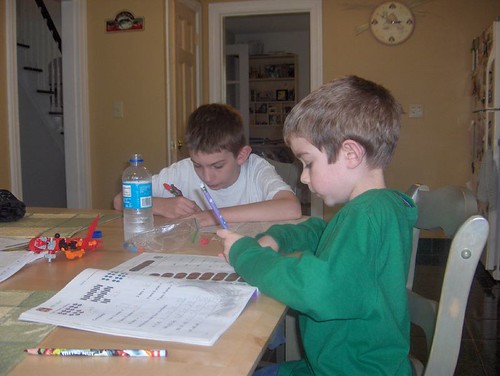
You may want to finish off the few hours of textbook learning in the morning and dedicate the afternoons to these kinds of activities. Given the fact that too many public school hours are wasted in meaningless activities ranging from talking to extra-curricular activities, do not allow public school hours to dictate the time you should spend teaching your child at home. Remember that at home, he is getting a high-quality one-to-one time that is highly productive.
About 1-3 hours of study is enough in the primary level. It is of course true that the more number of hours you put in, the more learning takes place. This is also the reason why homeschooling children are much smarter and more balanced than regular school going children.